
Thermodynamics MCQs
Thermodynamics is the study of energy transformations. In various reactions, the chemical energy within a molecule is released and can be converted into other forms of energy, such as mechanical work (e.g., burning fuel in an engine) or electrical energy (e.g., in a dry cell). Thermodynamics focuses on the initial and final states of a system, without considering the rate or method of the changes. The laws of thermodynamics apply to macroscopic systems that are either in equilibrium or transitioning from one equilibrium state to another.
ΔH for the reaction N2 + 3H2 ⇋ 2NH3
(a) ΔE – 2RT
(b) ΔE + 2RT
(c) ΔE – RT
(d) ΔH = RT
Find out the relationship between x, y and z considering below three reactions



(a) y = 2z – x
(b) x = y – z
(c) x = y + z
(d) z = x + y
What is the molar entropy change for melting of ice at 0℃, if ΔHf = 1.435 kcal/mol?
(a) 0.526 cal/(mol K)
(b) 5.26 cal/(mol K)
(c) 10.52 cal/(mol K)
(d) 21.04 cal/(mol K)
What will be the work done by 3 moles of an ideal gas when it expands spontaneously in a vacuum?
(a) zero
(b) infinite
(c) 3 joules
(d) 9 joules
An ideal gas is expanded isothermally at 300 K from 1 litre to 10 litres. Find the ΔE for this process (R = 2 cal mol-1 K-1)
(a) 9 L atm
(b) 1381.1 cal
(c) zero
(d) 163.7 cal
What will be the value of ΔH, if the forward and reverse reactions have the same energy of activation?
(a) ΔH = ΔG = ΔS = 0
(b) ΔS = 0
(c) ΔG = 0
(d) ΔH = 0
Find the temperature at which the below reaction will be in equilibrium if the enthalpy and entropy change for the reaction is 30 kJ mol-1 and 105 J K-1 mol-1 respectively
Br2(l) + Cl2(g) → 2BrCl(g)
(a) 273 K
(b) 300 K
(c) 450 K
(d) 285.7 K
What is the function of a catalyst in a chemical reaction?
(a) decrease rate constant of reaction
(b) increases activation energy of reaction
(c) reduces enthalpy of reaction
(d) does not affect the equilibrium constant of reaction
Which is true for the entropy of a spontaneous reaction?
(a) ΔS(system) – ΔS(surroundings) > 0
(b) ΔS(system) + ΔS(surroundings) > 0
(c) ΔS(surroundings) > 0 only
(d) ΔS(system) > 0 only
What will be the entropy change (ΔS), when an ideal gas undergoes a change in the pressure from pi to pf isothermally?
(a)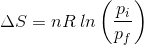
(b)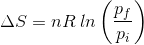
(c)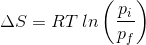
(d)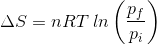
(a)