
Structure of Atom MCQs
Everything around us is composed of atoms, which are the smallest units of matter possessing all its chemical properties. An atom consists of a positively charged nucleus containing protons, which are positively charged, and neutrons, which are neutral. This nucleus is encircled by negatively charged electrons. In a neutral atom, the number of protons equals the number of electrons. An element’s atomic number is directly linked to its chemical and physical properties.
Orbital angular momentum of p electrons is
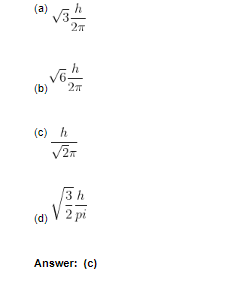
A gas X has Cp and Cv ratio as 1.4, at NTP 11.2 L of gas X will contain_______ number of atoms
(a) 1.2 × 10²³
(b) 3.01 × 10²³
(c) 2.01 × 10²³
(d) 6.02 × 10²³
How many orbitals can have the following set of quantum numbers, n = 3, l = 1, m1 = 0?
(a) 3
(b) 1
(c) 4
(d) 2
3p orbital has _ radial nodes
(a) three
(b) two
(c) one
(d) none
A 0.66 kg ball is moving with a speed of 100 m/s. Find its wavelength
(a) 6.6 × 10⁻³⁴ m
(b) 6.6 × 10⁻³² m
(c) 1.0 × 10⁻³² m
(c) 1.0 × 10⁻³² m
Electronic configuration of the outer shell of the element Gd with atomic number 64 is
(a) 4f4 5d5 6s1
(b) 4f3 5d5 6s2
(c) 4f5 5d4 6s1
(d) 4f7 5d1 6s2
The excitation energy of a hydrogen atom from its ground state to its third excited state is
(a) 12.75 eV
(b) 0.85 eV
(c) 10.2 eV
(d) 12.1 eV
The orientation of atomic orbitals depends on their
(a) spin quantum number
(b) magnetic quantum number
(c) azimuthal quantum number
(d) principal quantum number
Number of unpaired electrons in N2+
(a) 3
(b) 1
(c) 2
(d) 0
Maximum number of electrons in a subshell can be
(a) 4l + 2
(b) 4l – 2
(c) 2n2
(d) 2l + 1