Hydrocarbons MCQs
Compounds consisting of hydrogen and carbon are called hydrocarbons. These compounds can be straight-chain, branched, or cyclic. Hydrocarbons are naturally found in coal, natural gas, and many polymers like polystyrene and polyethylene. A hydrocarbon with all single C-C bonds is known as a saturated hydrocarbon (alkane), while those with double or triple C-C bonds are called unsaturated hydrocarbons (alkenes and alkynes, respectively). Various functional groups (such as halide, hydroxyl, aldehyde, and carboxylic groups) can also be attached to the carbon atoms in hydrocarbons.
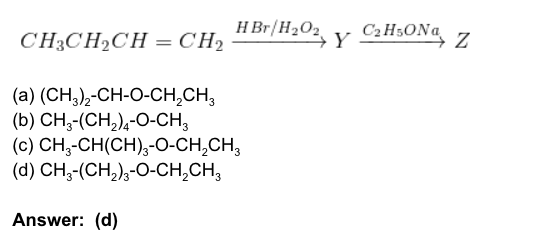
2. Identify Z in the given reaction:
Which one of the following compounds forms salt on reaction with NaNH2?
(a) C2H2
(b) C2H6
(c) C6H6
(d) C2H4
A compound having a bond angle of 180° is
(a) alkyne
(b) alkane
(c) alkene
(d) cycloalkane
The product obtained on heating 2-Bromopentane with potassium ethoxide in ethanol is
(a) 1-pentene
(b) 2-cis-pentene
(c) trans-2-pentene
(d) 2-ethoxy pentane
C6H5CHO is formed when C6H6 is treated with CO and HCl in the presence of anhydrous AlCl3. Name of the reaction is:
(a) Friedel-Crafts reaction
(b) Gattermann-Koch reaction
(c) Rosenmund reaction
(d) Stephen reaction
Which one of the following halides can be used in the Friedel-Crafts reaction?
(a) Isopropyl chloride
(b) Bromobenzene
(c) Chlorobenzene
(d) Chloroethene
Isopropyl iodide is formed after reaction of propene with HI, this is due to
(a) more stable free radical
(b) homolysis
(c) more stable carbanion
(d) more stable carbocation
Choose the process by which liquid hydrocarbons can be converted to gaseous hydrocarbons
(a) hydrolysis
(b) oxidation
(c) cracking
(d) distillation under reduced pressure
Which among the following reagents can be used to distinguish between CH2BrCH=CH2 from CH3CH=CHBr?
(a) Br2/CCl4
(b) cold KMnO4
(c) AgNO3/C2H5OH
(d) Ag(NH3)2OH
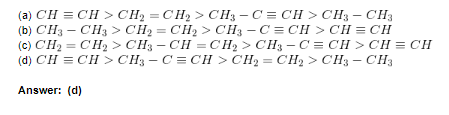
Find the correct order of increasing acidity